By Moehammad Aman Wirakartakusumah
Rektor IPMI, Anggota AIPI/AIPG, Fellows IAFoST, Anggota IUFoST dan PATPI, Professor Emeritus pada Departemen Ilmu dan Teknologi Pangan, dan Ilmuwan Senior pada SEAFAST Center, IPB University, Indonesia.
Abstract
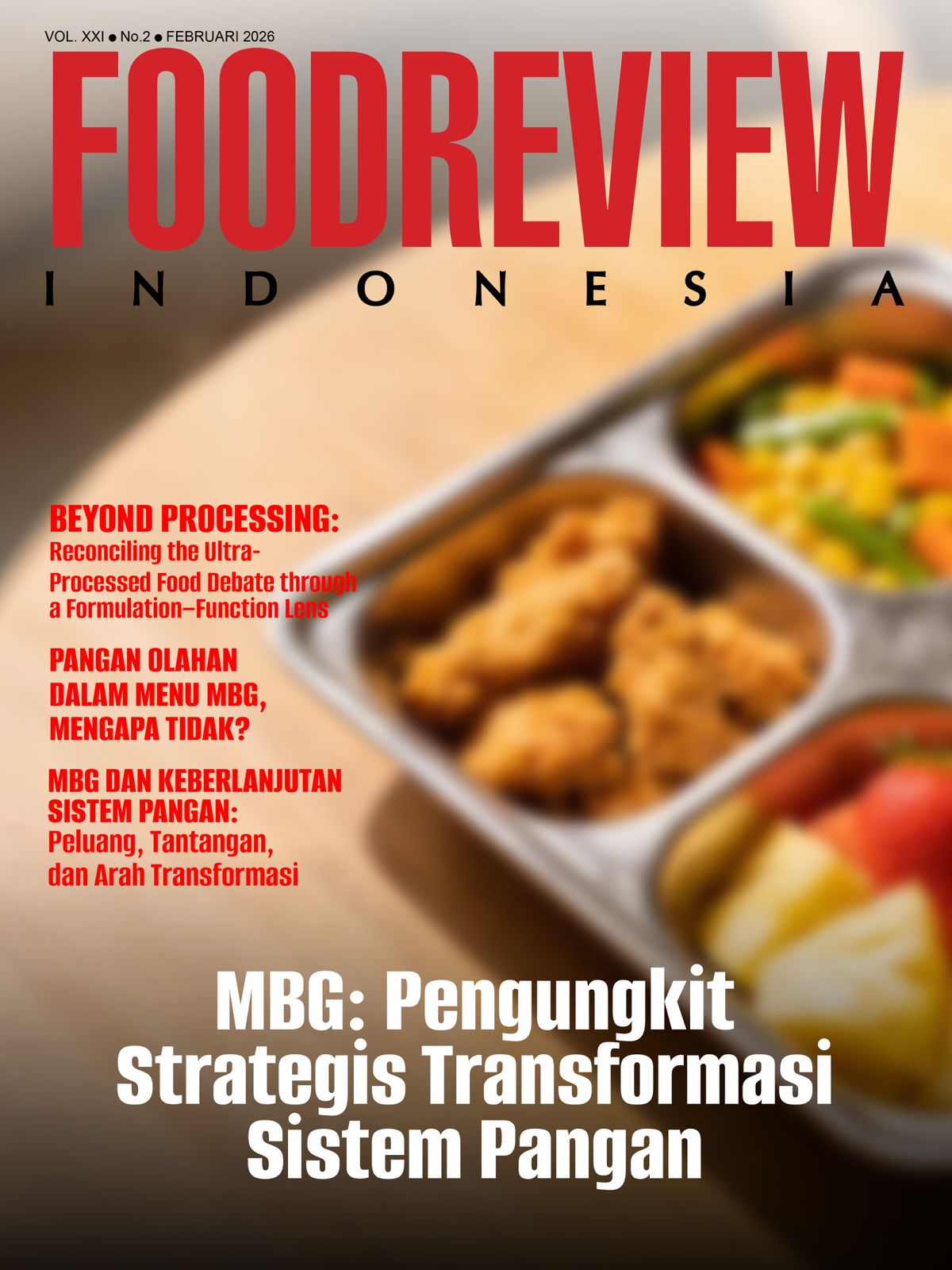
Debate around ultra-processed foods (UPFs) and the NOVA classification has become increasingly polarized, often framed as a divide between nutrition epidemiology and food science. While growing evidence links high UPF consumption to adverse health outcomes and drives precautionary regulatory calls, critics highlight conceptual limitations in NOVA, the heterogeneity of the UPF category, and the risk that a blanket “anti-UPF” stance may undermine beneficial uses of food processing— especially in low- and middle-income countries (LMICs). This paper proposes a balanced framework that distinguishes processing as a technological enabler from formulation and dietary patterns as the more proximate drivers of health effects, mediated through nutrient profile, energy density, food matrix, and non-nutrient components. The same industrial processes can yield both nutrient-poor discretionary products and beneficial foods such as fortified staples, specialized infant foods, and therapeutic products; thus, processing level alone cannot be treated as a universal causal agent of harm. Evidence from Indonesia and other ASEAN countries shows that UPFs still contribute a minority share of total energy intake, while home-cooked and informal-sector foods—often high in added sugar, salt, and fat—remain dominant, making a purely processing- centered narrative particularly problematic in LMIC contexts. We argue that public health strategies should prioritize formulation quality and overall dietary patterns, treating processing intensity as a secondary risk modifier. A formulation–function–processing lens provides a more constructive path toward advancing health, economic development, and food system transformation consistent with the SDGs and UNFSS 2021, and supports a shift from ideological polarization toward collaborative, evidence-based solutions.
Introduction:
The concept of “ultra-processed foods” popularised through the NOVA classification has reshaped global debate on diet and health. NOVA’s Group 4 has been adopted in hundreds of epidemiological studies and in emerging policy proposals. Recent umbrella reviews and meta-analyses report consistent associations between high UPF consumption and higher risks of obesity, type 2 diabetes, cardiovascular disease, depression, and all-cause mortality. These findings underpin WHO’s decision to establish a Guideline Development Group (GDG) on UPFs.
At the same time, food scientists and organisations such as the International Union of Food Science and Technology (IUFoST) have raised concerns about NOVA’s conceptual clarity and regulatory usefulness. NOVA’s Group 4 bundles together highly heterogeneous products, from sugar- sweetened beverages and confectionery to fortified breakfast cereals, plant-based analogues, infant formulas, and ready-to-use therapeutic foods, despite very different formulations, uses, and health impacts. This has motivated alternative frameworks, such as the IUFoST Formulation and Processing Classification (IF&PC) scheme, which explicitly separates what is in the product (formulation) from how it is made (processing).
A third strand argues for a “return” to traditional technologies and low- intensity processing, implying that traditional foods are inherently safer or healthier than modern industrial products. Yet in many real-world contexts—especially street and hawker foods in Asia—traditional dishes are very high in salt, sugar, and fat, and sometimes prepared under poor hygiene conditions. Simply replacing industrial with traditional processing, without improving formulations and dietary patterns, will not resolve the underlying health risks.
The UPF debate also intersects directly with the Sustainable Development Goals (SDGs). SDG 2 (Zero Hunger) and SDG 3 (Good Health and Well-Being) depend on food systems that can deliver safe, affordable, and nutritious diets at scale in low- , middle-, and high-income settings. SDG 12 (Responsible Consumption and Production) and SDG 17 (Partnerships for the Goals) require constructive collaboration between governments, scientists, civil society, and responsible parts of industry. If the UPF discussion hardens into a polarised “war” between proponents and opponents of processed foods, it risks fragmenting these partnerships, confusing consumers, and delaying practical solutions needed to meet the UN Food Systems Summit (UNFSS) 2021 vision and the SDG targets by 2030.
Artikel bersambung...
Klik Next › untuk melanjutkan membaca.
This paper seeks to move beyond the “for or against UPF” dichotomy by:
- Clarifying the distinction between
- Demonstrating that the same processing technologies can produce both harmful and beneficial products;
- Showing why both industrial and traditional foods can be unhealthy when formulation is poor;
- Highlighting why a processing-only narrative is risky for LMICs and for the SDG/UNFSS agenda; and
- Proposing a balanced, hybrid framework that can guide research, regulation, and innovation, and support healthy diets within planetary boundaries.
What the UPF evidence tells us – and what it cannot
Umbrella and systematic reviews of prospective cohort studies consistently report that higher UPF consumption is associated with increased risks of obesity, type 2 diabetes, cardiovascular disease, depression, and all-cause mortality, often with apparent dose– response relationships. Controlled metabolic studies add plausibility: for example, Hall et al. showed that participants offered an ad libitum UPF diet consumed more calories and gained weight compared to when they were offered an unprocessed diet matched for macronutrients, fibre, and sodium.
However, the UK Scientific Advisory Committee on Nutrition (SACN) and others note that it is still unclear whether UPFs are inherently harmful because of their processing, or because most UPFs in current food environments are high in free sugars, saturated fat, salt, and energy, and low in fibre and key micronutrients. Louie and colleagues argue that aggregating heterogeneous products into a single NOVA Group 4 oversimplifies the issue and obscures both harmful and potentially beneficial subcategories.
Monteiro and co-authors have reaffirmed their thesis that displacement of traditional dietary patterns by UPFs is a major driver of obesity and NCDs worldwide, urging regulatory strategies that directly target UPFs as a group. This has reinforced the perception of an “all-or-nothing” policy choice. In reality, the evidence strongly indicates that diets very high in current UPF products are harmful, but does not yet resolve how much of the risk is attributable to processing per se versus formulation, portion size, eating context, and broader food environments.
Processing versus formulation and dietary patterns
Processing is often treated as the primary villain in public discourse. Technologically and biologically, however, processing is a neutral set of tools, whereas formulation and patterns of consumption determine health effects.
Industrial processes—thermal treatment, drying, extrusion, fermentation, fractionation, high- pressure processing—can be deployed to:
- Reduce microbial and chemical risks;
-
Extend shelf life and reduce post-
-
Enable fortification with micronutrients and functional components; or
-
Create highly palatable, energy- dense, nutrient-poor products that drive overconsumption.
The same NOVA Group 4 technologies underpin:
- Clearly harmful products: sugar-sweetened beverages, confectionery, and ultra-palatable snacks;
-
Potentially beneficial products: fibre-rich, fortified cereals or dairy products that can improve nutrient intake when appropriately formulated;
-
Life-saving products: ready-to- use therapeutic foods, some infant formulas, and specialised clinical products indispensable in severe acute malnutrition and specific medical conditions.
If processing level alone were universally causal for harm, such beneficial UPF-category products could not exist. The primary proximal drivers of health risk or benefit are formulation (nutrient profile, matrix, additives) and how the food is used in the diet (frequency, portion size, and replacement of other foods).
In practice, many high-UPF diets combine unfavourable formulations with high frequency and large portions, in obesogenic environments. The real levers for health lie in what is in the food and how it is eaten—not in the mere fact that it is intensively processed.
LMIC and ASEAN realities – and the myth that “traditional” automatically means healthy
Artikel bersambung...
Klik Next › untuk melanjutkan membaca.
The stakes of mis-framing the problem are particularly high in LMICs Global reviews of food-based dietary guidelines (FBDGs) show that high- income and upper-middle-income countries are much more likely to have mature, nationally implemented guidelines than low- and lower-middle- income countries. Within ASEAN, Indonesia, Malaysia, the Philippines, Singapore, Thailand, and Viet Nam have relatively mature, general-population FBDGs, while Cambodia and Myanmar have more limited, group-specific guidance, and Lao PDR and Brunei are still developing general-population FBDGs.
UNICEF and FAO reviews indicate that only a minority of low- and lower-middle-income countries have full FBDGs, compared with a majority of upper-middle- and high-income countries. This coverage gap already constrains the ability of many LMICs to provide coherent, context-appropriate dietary advice.
Intake data also show that UPFs are not yet dominant energy sources in many Asian LMICs. In Jakarta, the only NOVA-coded individual survey published to date found that unprocessed foods provided about 57% of total food weight and 52% of energy, processed culinary ingredients about 22% of weight and 30% of energy, while UPFs contributed roughly 20% of weight and 16% of energy. A global comparative review estimates Indonesia’s UPF share at around 15–16% of energy, compared with about 50–60% in the US, UK, Canada, and Brazil.
Thus, the main dietary challenge in many ASEAN settings is not a wholesale replacement of traditional diets by UPFs, but the coexistence of nutrient-poor traditional and modern foods, both often high in sugar, salt, and fat.
A simplistic “avoid all UPFs” message therefore risks:
-
Stigmatising fortified staples and specialised products that are important for controlling
-
Ignoring very high sodium, sugar, and fat levels in home-cooked and hawker
-
Confusing consumers and policymakers about priorities for action.
Proposals to rely only on “traditional technologies” or “less intense” processing as a substitute for NOVA Group 4 also do not automatically address the true causes of unhealthy diets. In many Asian cities, traditional snacks and fried foods sold by street vendors use simple technologies but contain very high levels of salt, sugar, and fat, with frequent re-use of oils and variable hygiene conditions. From a metabolic and cardiovascular perspective, such foods can be as harmful—or more harmful—than some industrial products with better formulations.
Romanticising “traditional” processing in opposition to “industrial” processing repeats the same conceptual error as NOVA: it focuses on how food is made instead of what it contains and how it is consumed. For LMICs and ASEAN, the central challenge is to improve formulation and dietary patterns across the entire food system, including both household/hawker foods and packaged products, while harnessing responsible processing to support safety, fortification, waste reduction, and climate resilience.
Who loses if we stay trapped in the “UPF war”?
The ongoing polarization in the international community about food classification—especially the disagreement between NOVA system supporters and critics—is a threat to public health progress. This situation does not only affect scientific circles; it primarily harms the well-being of consumers and vulnerable populations. For consumers, especially in LMICs:
- Polarised slogans such as “avoid all UPFs”, “eat only real food”, or “traditional is always best” oversimplify reality and can undermine confidence in essential public health tools like food fortification, school feeding, and therapeutic nutrition programmes;
- Conflicting messages arise when some dietary guidelines and campaigns emphasise “minimally processed real foods”, while nutrient-profiling systems and marketing regulations still permit “healthy”, “high-protein”, “functional”, or “nutritious” claims on products classified as UPF.
For governments and regulators:
-
Excessive focus on processing level may divert political energy away from regulating sugar, salt, unhealthy fats, energy density, marketing to children, and portion size, which have clearer causal links to NCDs;
-
Blanket “anti-UPF” or “anti- industrial” rhetoric risks undermining investment and innovation in reformulated products that genuinely improve nutrient profiles and environmental footprints, as well as in safe, convenient foods needed for urban, time-constrained households.
Artikel bersambung...
Klik Next › untuk melanjutkan membaca.
From an SDG perspective, a prolonged and polarised UPF “war” has at least three negative consequences:
- It can weaken progress towards SDG 2 and SDG 3 by casting doubt on the legitimate use of processing and fortification to reduce undernutrition, micronutrient deficiencies, and diet-related NCDs, especially in LMICs;
- It can slow action on SDG 12 by encouraging simplistic “good vs bad processing” narratives instead of incentivising innovation towards healthier formulations, reduced food loss and waste, and lower environmental footprints across value chains;
- It can undermine SDG 17, as mistrust between stakeholder groups (nutritionists, food scientists, regulators, industry, farmers, and consumer organisations) makes it harder to build the multi-actor coalitions that the UNFSS 2021 identified as essential for food systems transformation.
In short, staying trapped in an ideological war over “UPF vs real food” or “traditional vs industrial” risks slowing progress towards 2030 goals, increasing confusion, and leaving many of the real drivers of poor diet quality insufficiently addressed.
A hybrid formulation– function–processing framework within planetary boundaries
To move beyond the current impasse and align with both health and planeta objectives, a hybrid framework with three interacting dimensions is proposed:
- Formulation quality (primary focus)
-
Nutrient profile: free sugars, sodium, saturated and trans fats, fibre, key micronutrients;
-
Energy density and typical portion size;
-
Additive load and combinations with plausible biological effects.
- Function in the diet and food system
-
Essential / beneficial: fortified staples and condiments, therapeutic foods, some infant products, emergency rations;
-
Neutral / context-dependent: reformulated products whose impact depends on broader dietary patterns;
-
Discretionary / clearly harmful: sugar-sweetened beverages, many confectionery items, energy-dense nutrient-poor snacks, and some fast foods.
- Processing intensity and type (secondary modifier)
-
Degree to which the food matrix is altered and shelf life extended;
-
Technological markers associated with hyper-palatability, convenience, and ease of overconsumption;
-
Environmental and resource implications (energy use, packaging, waste), relevant to planetary boundaries and SDG
Within this framework:
- Some products clearly fall in a high-risk zone: poor formulation, discretionary function, and often high processing intensity (e.g. SSBs, many confectionery items, salty snacks). These map closely to “classic junk” UPFs and are legitimate targets for taxes, marketing restrictions, and strong front-of-pack warnings.
- Other products occupy a strategic zone: higher processing intensity but good formulation and essential function (e.g. fortified flours, iodised salt, therapeutic foods, some complementary foods). These require quality standards and continuous improvement, not blanket discouragement.
- A third group are priority innovation targets: processing- intensive products whose formulations have been improved (lower sugar and salt, healthier fats, higher fibre and plant protein, reduced environmental footprint). Evidence is still developing, but they may play an important role in shifting diets within planetary boundaries.
This approach preserves the insight that many current UPFs are problematic, while avoiding the logical and practical errors of treating all UPF— or all industrially processed foods—as equally harmful or unnecessary. It also recognises that responsible processing is indispensable for reducing food loss and waste, ensuring safety, enabling fortification, and adapting food systems to climate shock, especially for needy communities.
Research and policy agenda: From belief to testable hypotheses
A more balanced debate requires a more precise research and policy agenda:
- Decomposing the “UPF effect”
- Design analyses and intervention studies that explicitly separate the contributions of nutrient profile, energy density, additives, eating patterns, and residual processing effects;
-
Move beyond simple correlations by applying robust causal inference methods and triangulating evidence fromcohort studies, controlled trials, and mechanistic research.
Artikel bersambung...
Klik Next › untuk melanjutkan membaca.
Sub-typing UPFs and traditional foods
- Within NOVA Group 4, create transparent subcategories (SSBs, confectionery, savoury snacks, ready meals, fortified staples, plant- based analogues, medical foods) and conduct meta- analyses by subtype rather than treating all UPFs as homogeneous;
-
Apply similar scrutiny to traditional and street foods, recognising that many are high in sugar, salt, and fat and warrant reformulation and behavioural interventions even if they involve low-intensity processing.
Trials and pragmatic interventions in LMICs
- Test realistic substitution scenarios: improving nutrient profiles of hawker/home foods and selectively restricting high- risk UPF categories; strengthening fortification; promoting “best-in- class” processed foods in school meals and social protection programmes;
-
Evaluate combined impacts on nutrition, health, affordability, and environmental indicators.
Mechanistic and planetary health research o Investigate specific pathways
- Investigate specific pathways whereby processing may matter independently of nutrients (food structure, speed of eating, microbiome changes, process-induced contaminants, packaging chemicals), while controlling for formulation;
-
Integrate environmental metrics (greenhouse gas emissions, water use, biodiversity impacts) to ensure that reformulation and processing choices are consistent with planetary boundaries.
Governance and guideline
-
For FAO, WHO, and Codex, convene a joint expert consultation on “Processing, Formulation, Planetary Health and Healthy Diets” with three deliverables:
-
A technical report on the state of evidence, explicitly distinguishing established and uncertain claims;
-
Guidance on integrating processing markers into nutrient-profiling systems used for labelling and marketing regulation;
-
Options for countries to use balanced messages in dietary guidelines that avoid blanket stigmatisation of processing or romanticisation of traditional foods, while clearly discouraging high-risk formulations and patterns of consumption.
Conclusion: Working together for healthy diets within planetary boundaries
The ultra-processed food debate has performed a valuable service by drawing attention to the dangers of modern “junk diets” and the structural forces that promote them. It has also inspired important methodological debates about how we classify foods and measure exposure in epidemiology and surveillance.
However, when processing is treated as a moral category and NOVA as an article of faith; when “traditional” is automatically equated with “healthy”; and when we neglect formulation, portion size, and food environments, the debate risks becoming a war of beliefs rather than a forum for scientific reasoning and solution-oriented policy.
A more constructive path starts from three recognitions:
-
Processing is a tool, not a destiny. The same industrial technologies can produce both harmful and beneficial products.
-
Formulation and dietary patterns are the proximal determinants of most health effects, with processing intensity and type acting as important but secondary modifiers.
-
Traditional and industrial foods alike can be either health-promoting or health-damaging, depending on sugar, salt, fat, energy density, and broader patterns of use.
A framework that judges foods by their formulation quality, function in the diet and food system, and demonstrated health and environmental impacts, while treating processing level as a contextual factor rather than a universal villain, is more scientifically defensible and better aligned with the realities of LMICs, including ASEAN. It offers regulators
clearer levers to act on (sugar, salt, fat, energy density, marketing practices), protects and improves strategic uses of processing and fortification for needy populations, and supports innovation towards truly healthier and more sustainable products.
Most importantly, such a balanced approach opens space for nutritionists, food scientists, public-health professionals, industry, farmers, and civil society to work together, rather than against one another, in building food systems that are health- promoting, economically inclusive, and environmentally sustainable. This collaboration is essential if we are to deliver healthy diets within planetary boundaries and achieve the SDGs by 2030, especially SDG 2, SDG 3, SDG 12, and SDG 17.
Artikel bersambung...
Klik Next › untuk melanjutkan membaca.
Reference:
http://foodreview.co.id/pdf/Referensi%20-%20Artikel%20Beyond%20Processing.pdf
.jpg)

.gif)